
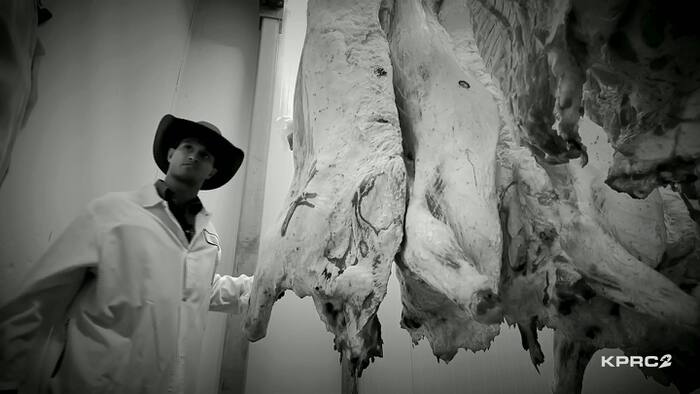
Someone is supposed to be checking your food before it reaches your plate.
Anthony Thomas checks his own.
“This morning is harvest day,” Thomas said. “I’ve been raising cattle and butchering beef all my life,” he said.
Thomas owns ‘Thomas Cattle and Catering’ in Texas Hill County in Houston.
The cattle he sorts routinely head to a processing plant. What happens next, he says, is what sets his beef apart.
“All our beef is custom harvest, dry aged, and custom butchered, from our pasture, to your plate,” Thomas said.
Most beef, he argues, passes through many more hands, from factories to warehouses to processing plants. That, he said, makes it “very easy for these pathogens, contaminants, diseases” to get into the meat.
“There’s just a problem in this country with people knowing about where their food comes from.”
Knowing where your food comes from depends on someone checking it. On that front, the federal government is falling far short.
Under a 2011 law, the FDA is supposed to inspect about 19,200 foreign food facilities a year. The Government Accountability Office, Congress’s watchdog, found the agency does about 900, or roughly 5%.
The gap comes after a summer that showed what can go wrong.
In August, the U.S. Department of Agriculture announced the recall of nearly 30,000 pounds of beef imported from Argentina. It was one of many:
Thomas says imports are driven by price. Companies buy meat in high volume “for the cheapest price,” he said, to “make the most amount of money.”
Far fewer than Congress required.
Congress wrote the rules for how the FDA enforces food safety in the FDA Food Safety Modernization Act, signed into law in 2011.
Lawmakers considered it the most sweeping overhaul of federal food safety standards in decades. The goal was to prevent contamination in the U.S. and abroad, rather than react after the fact.
That shift hasn’t been easy.
“There’s a lot of facilities out there producing a lot of food that people are not taking a look at,” said Steve Morris, director of the Government Accountability Office’s natural resources and environment team. Morris oversees food and agriculture issues. The GAO has labeled federal food safety oversight “high risk” since 2007.
The scale is enormous.
“There’s 300-plus million people, and hopefully they’re eating three times a day, right? That’s a billion servings of food daily,” Morris said.
In January, Morris and the GAO examined whether the law’s framework is working. Among the findings:
If the agency doesn’t have enough people, Morris says it should tell lawmakers.
“They need to go back to Congress and kind of explain that. Lay that out and say here’s what we can do with the folks we have. Here’s what we can’t do.”
Federal cuts add to the challenge. The Trump administration announced plans to cut 20,000 employees from the Department of Health and Human Services, which works out to roughly 4,000 to 4,500 fewer FDA workers.
The FDA did not make an official available for an interview but answered written questions. The agency said it “has previously reported not being adequately resourced to meet” the foreign inspection target.
It noted that the 19,200 target applies to every registered foreign facility “regardless of the risk profile.” At the GAO’s recommendation, it is studying how many foreign inspections are actually needed to match oversight of domestic facilities, and what staffing that would take.
The agency said it has more than 400 investigators who handle both domestic and foreign food inspections and is “actively recruiting additional staff.”
It did not say how many work on foreign inspections, nor did it provide inspection counts; instead, it directed readers to its public data dashboard.
It depends on how you count.
Davonna Koebrick oversees Texas’ rapid-response team for foodborne illness outbreaks at the Texas Department of State Health Services.
“The number of recalls actually is lower than it was last year,” she said, while acknowledging there were many cases of illness.
The federal data is less clear. Two agencies split food oversight, with the USDA covering meat, poultry and egg products and the FDA covering nearly everything else. They report recalls very differently.
A review of raw data posted online by both agencies shows:
No. And they don’t prevent illness, either.
“Recalls, by their nature, are pretty much not preventative,” Morris said. “It’s a tool that’s used once something is identified.”
What a recall can and can’t do:
Illness is also hard to count.
“We’re potentially talking about millions of people getting sick every year – but there’s a lot of potential underreporting of foodborne illness,” Morris said.
The system behind all of it is sprawling.
“There’s basically 30 laws that govern this system,” Morris said, along with federal agencies, states, tribal entities and industry partners. “So, it’s very big. It’s very broad. It’s very complicated.”
When people do get sick, Koebrick’s team in Texas works with the FDA on what’s called a traceback investigation: following contaminated food back to where it came from.
“We work with FDA on a daily basis,” she said. “I like to say it’s kinda like NCIS.”
This summer’s Cyclospora outbreak shows how it works:
The global supply chain is the challenge.
“There’s a large portion of our food that’s coming from somewhere else,” Morris said.
Thomas thinks so. The federal watchdog isn’t convinced.
Back on the ranch, Thomas rides a tractor through the pasture, moving cattle from one pen to the next. “Come on, girls,” he calls.
“We’re very transparent about our whole process,” he said. “We want people to know where their food comes from.”
Thomas has a business interest, of course. He sells beef straight from his ranch. He’s not immune to illness, but he says his small-scale operation reduces the risk.
Asked about that view, Morris called it “an interesting perspective.” He said the government has “a very elaborate process” for deciding whether meat is safe.
Once foreign meat is approved, Morris said, the USDA treats it as equivalent to meat produced in the U.S. The main question for imports isn’t quality but safety: whether foreign beef could “introduce bad diseases” to the U.S.
And Thomas concedes local ranchers can’t replace imports. Asked whether U.S. ranchers could supply all the beef sold in grocery stores, he said: “The answer is no.”
That makes how imported meat is inspected all the more important.
Domestic meat goes through its own inspection. When Thomas took his cattle for processing, he walked through the steps:
The paperwork, policies and procedures behind that stamp have become an industry of their own.
Brian Kellerman owns Kellerman Consulting, one of the companies that help food businesses get ready for government inspections. Kellerman does not work with Thomas Cattle and Catering.
Most inspections happen without the public ever hearing about them. But experts agree there are holes in the inspection process.
Morris says it starts with Congress.
“Congress really needs to develop, for lack of a better word, kind of an overarching national strategy to guide food safety oversight,” Morris said. “You’ve got to bring everyone together. You’ve got to come up with a coordinated plan. You got to identify the goals, the leaders, the resources needed and then you go from there.”
Thomas has his own answer. Asked what he would do if he ran the USDA or the Department of Health and Human Services, he said: “I would try to source 100 percent American beef for Americans.”
Recalls tell only part of the story, because many illnesses never get reported. Here’s what you can do:


